
 YouHired
The Ultimate Guide to Technical Interviews: Ace Your Next Coding Job
YouHired Team
Career & Product Experts
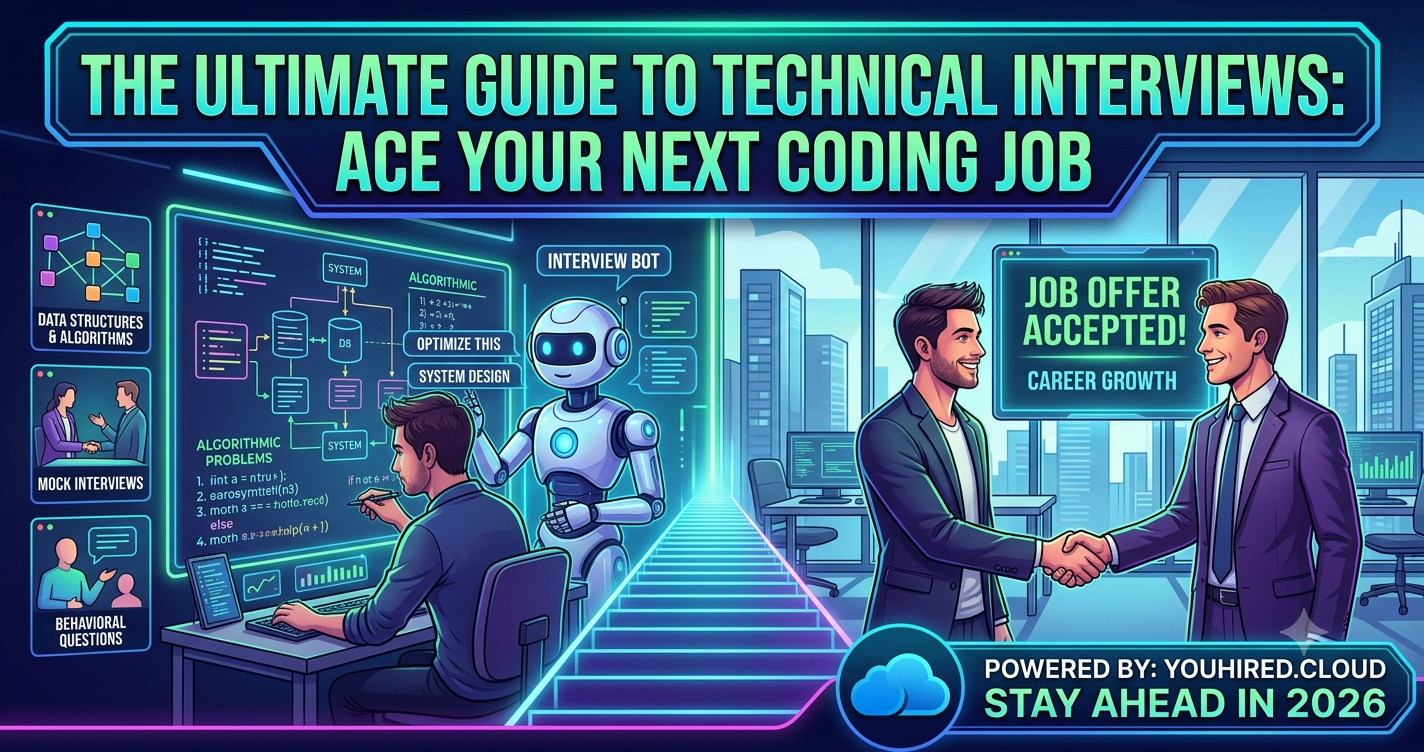
The Ultimate Guide to Technical Interviews
Landing a job in tech is rarely just about knowing how to code. It is about demonstrating how you think under pressure, how you communicate complex ideas, and how you collaborate with a team. The technical interview process can be daunting, but with the right strategy and preparation, you can turn anxiety into confidence.
In this comprehensive guide, we will break down every stage of the technical interview process, from the initial phone screen to the final onsite round.
Understanding the Interview Structure
Before you open a LeetCode problem, it is crucial to understand the typical structure of a technical interview loop. While every company is different, most follow a similar pattern:
- The Recruiter Screen: A brief call to discuss your resume, salary expectations, and general interest.
- The Technical Screen: A 45-60 minute coding challenge, usually via a platform like HackerRank or a shared Google Doc.
- The Onsite (or Virtual Onsite): A series of 3-6 back-to-back interviews covering coding, system design, and behavioral aspects.
Phase 1: Data Structures and Algorithms
This is the meat of the interview. You need to be fluent in the fundamental building blocks of computer science. You are not expected to memorize every algorithm, but you must be able to recognize patterns and optimize solutions.
Key Topics to Master
- Arrays & Strings: Two pointers, sliding window, hashing.
- Linked Lists: Reversal, cycle detection, slow/fast pointers.
- Trees & Graphs: DFS, BFS, traversals, recursion.
- Heaps & Stacks: Priority queues, monotonic stacks.
Understanding Big O Notation
Analysis is just as important as the solution. You must be able to explain the time and space complexity of your code.
Phase 2: System Design
For mid-level and senior roles, system design is critical. This round tests your ability to build scalable and robust systems. You won't be writing code; you will be drawing boxes and lines on a whiteboard.
How to Approach System Design
- Clarify Requirements: Functional vs. non-functional requirements (e.g., read-heavy vs. write-heavy).
- Estimations: Calculate QPS (Queries Per Second), storage, and bandwidth.
- High-Level Design: Define APIs, data models, and the overall architecture.
- Deep Dive: Discuss specific components like Load Balancers, Caching, Database Sharding, and Message Queues.
Phase 3: Behavioral Questions
"Culture fit" is not a buzzword; it is a business necessity. Companies want to hire people they can work with. Use the STAR Method (Situation, Task, Action, Result) to structure your answers.
Common behavioral questions include:
- Tell me about a time you had a conflict with a coworker.
- Describe a project where you failed. What did you learn?
- How do you handle tight deadlines?
Pro-Tips for Interview Day
- Think Out Loud: Silence is your enemy. Narrate your thought process so the interviewer can follow your logic.
- Don't Pretend to Know: If you are stuck, admit it and explain how you would find the answer. Honesty goes a long way.
- Ask Questions: An interview is a two-way street. Ask about the team dynamics, tech stack, and challenges they face.
Conclusion
Consistency is key. Dedicate time every day to practice coding, design systems, and refine your soft skills. The journey to your dream job is a marathon, not a sprint. Good luck!