
 YouHired
Hiring Crisis in India: Talent Shortage or Lack of Talent Translation?
YouHired Team
Career & Product Experts
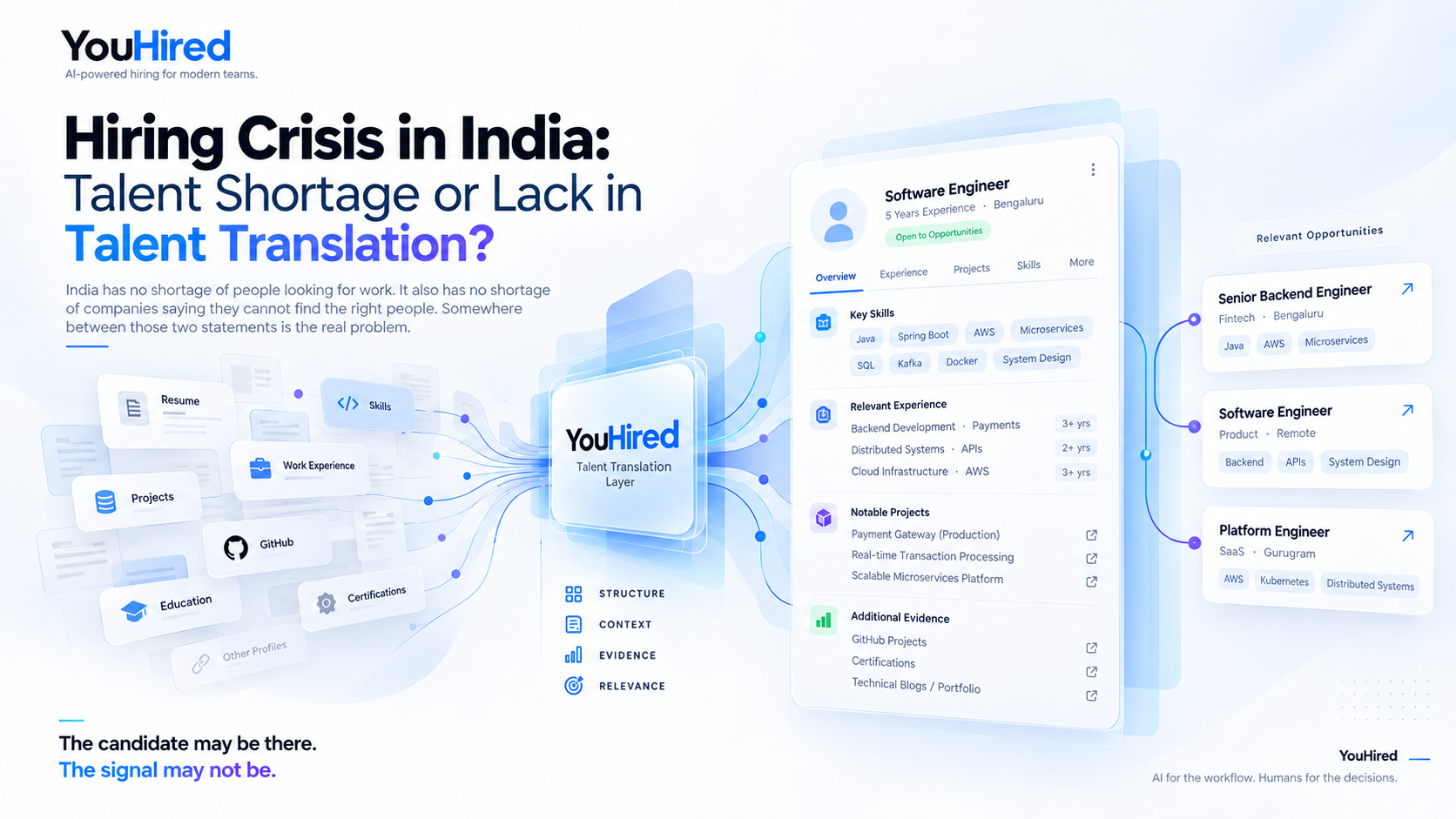
India has no shortage of people looking for work. It also has no shortage of companies saying they cannot find the right people.
Somewhere between those two statements is the real problem.
Let's start with the uncomfortable contradiction
India's hiring conversation usually starts with the same sentence: there isn't enough skilled talent.
And on-ground reality is not so far from the truth.
A 2026 Global Talent Shortage Survey conducted by ManpowerGroup describes that 82% of employers nationwide reported difficulties in finding the right talent. That is not a small problem.
But then look at the other side.
A 2024 report from the International Labour Organization on Employment in India found that the unemployment rate was 29.1% among young graduates in 2022, compared to 3.4% among people within the same age group who were illiterate.
When these two facts are put next to each other, an obvious question comes to us:
How can employers struggle so much to find the right talent when there is a whole pool of young, educated people who themselves are struggling to find suitable work?
I don't think the answer is simply "India has bad talent."
And I don't think it is simply "companies don't know how to hire."
The reality is messier.
India has a genuine skills shortage in some areas. It also has a skills mismatch. And sitting right between the two is another problem that doesn't get enough attention: we are not always very good at translating talent into something a hiring system can actually understand.
The candidate may be there.
The recruiter may simply not see the full picture.
Where the problem starts
A recruiter says, "We need a backend engineer."
A candidate says, "I am a backend engineer."
The recruiter searches.
The candidate does not appear near the top.
Now both sides walk away thinking the other side has a problem.
But sometimes neither does.
The candidate may have worked on backend systems for years. They may have handled databases, worked with AWS, built APIs, shipped real software and solved production issues.
But their job role was titled "Software Engineer."
Maybe the project that demonstrates their abilities best is sitting on a GitHub repository.
Perhaps it is the fourth bullet in their CV that shows their relevant work.
Maybe the terminology used in their job description was different.
Perhaps the recruiter has 40 seconds for each individual resume while screening 400 resumes.
Talent exists.
The information connecting that talent to the opportunity does not.
That is the part we find particularly interesting at YouHired.
Yes, India really does have a talent shortage
It would be wrong to swing too far in the other direction and pretend the shortage is imaginary.
It isn't.
LinkedIn's 2025 data points to something significant: roughly 70% of the skills people rely on in most jobs are expected to change between 2015 and 2030.
Tech hiring makes that shift pretty clear. foundit's 2025 hiring analysis found IT hiring was up 30% year over year, with demand especially hot in AI, cloud, data engineering, and cybersecurity. In 2025, 2.90 lakh AI job postings were live, and AI roles were on track to grow another 32% in 2026.
So yes, some jobs are genuinely hard to fill.
The market simply doesn't have enough ready-to-hire people for some specialised roles.
But even that doesn't explain the full picture.
Because the question is not only whether talent exists.
The question is whether employers can find, understand and evaluate the talent that does exist.
There is also a discoverability problem
Mercer | Mettl's India's Graduate Skill Index 2025 assessed more than one million students across more than 2,700 campuses. Its reported overall employability figure was 42.6%, while the figure for AI and ML roles was 46.1%.
These numbers need to be read carefully. This isn't saying the rest of India's graduates are unemployable.
The more useful point is this: a degree doesn't automatically mean you're ready for a specific role.
But there is another step after employability.
Even if someone is capable of doing a job, can a recruiter recognize that capability from the information available to them?
That is a different question.
And it is the question that led us to think about what we call "talent translation."
So, what do we actually mean by Talent Translation?
At YouHired, we use it to describe the gap between what someone can really do and what an employer can actually understand about them during hiring.
Think about how it usually goes:
Candidate → Resume → Recruiter
It looks simple.
In reality, a lot gets lost in the middle.
We think the better flow is:
Capability → Evidence → Context → Relevance → Decision
A candidate has capabilities.
Those capabilities leave evidence behind. That might be a project, a production system, a measurable result, a technical build, a portfolio, an open-source contribution, or the kinds of problems someone has already dealt with on the job.
Then comes context.
Where did they use the skill? How deeply? What did they actually own? What was the outcome?
Then relevance.
How closely does that evidence relate to this particular job?
Only after that should we reach the decision.
That sounds obvious when written down.
Most hiring systems still don't make that journey particularly easy.
The job description has a translation problem too
We usually talk about candidates being difficult to understand.
Job descriptions deserve some attention as well.
A hiring manager might tell a recruiter:
"We need a strong backend engineer."
By the time that requirement lands on a job board, it can get boiled down to a list:
Java, Spring Boot, Microservices, REST API, AWS, SQL, Kafka, Docker, Kubernetes, 5+ years.
Next thing you know, everyone is playing the keyword game.
Candidates are trying to squeeze the right words into their resumes.
Recruiters are trying to spot those same words.
Screening tools count the right words.
And somewhere in the process, the actual requirement gets buried.
Maybe the company doesn't need someone who has touched exactly eight different technologies.
Maybe what it really needs is someone who can build and maintain distributed backend services—and keep them running reliably at scale.
Those are not the same requirement.
The first is a list.
The second is a capability.
Good hiring starts when we can make that distinction.
The resume is useful. It is just not enough anymore.
I don't think resumes are going away.
They shouldn't.
A good resume is still one of the fastest ways to understand someone's professional journey.
The problem is that we have gradually asked the resume to do too much.
We take a two-page document and expect it to cover years of experience, skills, projects, achievements, education, technical exposure and professional growth.
Something has to get lost.
Take a developer with Python, FastAPI, PostgreSQL, AWS and Docker, three years of experience and a real-time analytics project.
On paper, that sounds relevant.
But what did they actually build?
What part did they own?
Was the system used in production?
What decisions did they make?
How complex was the problem?
What did it actually achieve?
A resume can point us in that direction.
It cannot always contain all of it.
That is why we increasingly see the resume as a summary of evidence, rather than the evidence itself.
AI is making resumes better. That doesn't automatically make hiring better.
AI can take an average resume and make it look sharp in minutes.
It can rewrite bullet points, clean up grammar, tighten the structure, and produce a professional summary almost instantly.
That's genuinely useful.
But there's a catch.
When everyone can produce a polished document, the polish itself stops telling you much.
The hiring question moves back to where it should have been:
What can this person do? And does their experience line up with the problem we need them to solve?
The recruiter side is changing too.
LinkedIn's Future of Recruiting 2025 found that 37% of the talent professionals they surveyed were either experimenting with generative AI or already using it in their work. Those already using it said it cut their workload by around 20% on average.
That's a big deal.
But AI can only work with what it's given.
If candidate information is scattered and patchy, AI just helps you process that mess faster. It doesn't magically turn fragmented information into good hiring judgment.
We don't think the future of hiring is "AI picks the candidate."
We think it is:
"AI helps the recruiter understand the candidate faster."
Skills-first hiring is moving in the right direction. But skills alone aren't enough.
There is a reason the industry is moving toward skills-based hiring.
LinkedIn's 2025 research found that companies with the highest levels of skills-based searches were 12% more likely to make a quality hire than companies with the lowest levels.
LinkedIn has also reported that skills-based hiring could expand talent pools in India by roughly 11.4 times compared with relying on traditional signals.
That is significant.
But even skills-first hiring can become another checkbox exercise.
Python.
AWS.
SQL.
React.
Java.
Fine.
Now what?
The better question is:
Where has the candidate demonstrated those skills?
A person listing Python and a person who has actually built a production data pipeline using Python are not giving us the same amount of information.
The skill is the starting point.
The evidence is where things get interesting.
The hidden problem with filtering
Recruiters have to filter.
There is no realistic alternative when hundreds of people apply for one role.
The problem is not filtering itself.
The problem is what we filter on.
Years of experience matter. Job titles matter. Previous employers matter. Degrees matter. Keywords matter.
But all of them are proxies.
And proxies become weaker as careers become less linear.
Someone might have started in support, moved into automation, then software engineering, and eventually data engineering.
Or they may have learned through freelancing, open source, internships, personal projects, or simply by figuring things out on their own.
They could be genuinely capable and still look "wrong" to a hiring system because that system is looking for the same titles and backgrounds it has always looked for.
That is where a hiring system can accidentally filter out potential while believing it is only filtering for relevance.
And then there is India's Tier-2 and Tier-3 talent story
India's tech scene isn't just Bengaluru, Hyderabad, Pune, Gurgaon, and a few other big names anymore.
Talent is distributed much more widely.
foundit's 2025 hiring analysis points toward increasing hiring activity beyond traditional metropolitan centres, including growing participation from Tier-2 cities.
The World Economic Forum says two-thirds of companies in India feel they need to tap into more diverse talent pools for new and emerging roles.
That matters.
Because expanding into new places only works if hiring can judge what someone can do—not just whether they come from a background that feels familiar.
Again, the issue may not be the absence of talent.
It may be the weakness of the signal.
How should the problem actually be diagnosed?
Hiring needs to be looked at as a process rather than a collection of tools.
At a basic level, there are six questions:
1. What does the company actually need?
Not the title. Not the keyword list. The actual capability and outcome.
2. Can we find the right talent who might have that capability?
Finding the right people shouldn't hinge on whether their job title or keywords match exactly.
3. What do we have as evidence?
Experience matters. So do projects, outcomes and the actual technical work someone has done.
4. What's the context?
Where did the candidate demonstrate the skill? What did they own? How complex was the work?
5. How relevant is that evidence to this role?
Someone can be good and still be wrong for a specific role. Relevance depends on context.
6. With whom lies the final decision?
The human.
AI can help organise information and surface signals. But the hiring decision belongs to the recruiter and the hiring team.
Where YouHired fits into this
YouHired didn't start with some big theory.
It started with one simple thing:
A person is not a resume.
The platform is built around structured candidate information, not around the resume as if that tells the whole story.
People have skills. They have experience. Projects. Education. Portfolios. Other proof of what they can actually do.
The useful part is getting all of that into a format recruiters can actually search, read and make sense of.
For recruiters, that means being able to search and filter candidates, open structured profiles, check skills, experience and projects, and see more details when it's relevant and they're allowed to.
The goal isn't to replace the recruiter's judgment.
It's to save them from spending hours piecing a candidate's story together from scattered information.
The workflow we are working toward is:
Requirement → Discovery → Evidence → Relevance → Decision
More data is not necessarily better data
Recruiters don't need another system handing them 50 more fields to scroll through.
They need the information that helps them make the call.
Picture two developers.
Both have Java, Spring Boot, SQL and AWS.
Both have four years of experience.
Both have three projects.
They look almost identical.
Now add context.
Candidate A built internal APIs for a small engineering team.
Candidate B designed and maintained Spring Boot microservices that handled high-volume transaction workflows, deployed on AWS, and backed by PostgreSQL.
That doesn't automatically make Candidate B the better person.
But for a specific backend role, that profile gives a recruiter far more useful evidence to work with.
That is what we mean by talent translation.
It takes "I have this skill" and moves it toward:
"Here is where I used it, what I did with it, and why it may matter here."
What should a better hiring system translate?
Skills into capabilities
Python is a skill. Data engineering, automation, backend development and machine learning can be capabilities built around it.
Experience into evidence
"Worked on backend development" tells us very little. What the person actually built, owned and improved tells us much more.
Projects into context
For people just starting out, projects often show more than a job title ever could—technical depth, ownership and problem-solving.
Job descriptions into real requirements
Before searching for candidates, companies should understand the problem the person will solve, the capabilities required and what evidence would demonstrate those capabilities.
And candidates have a role in this too
Talent translation isn't just a recruiter thing.
Candidates can make their own profiles easier to understand.
A strong professional profile should make five things clear:
- What can I do?
- Where have I done it?
- What did I actually own?
- What evidence can I show?
- Why is that experience relevant?
This becomes even more important when AI makes generic professional language incredibly easy to produce.
"Results-driven professional."
"Passionate technology enthusiast."
"Strong team player."
Maybe.
But none of those statements tells a recruiter very much.
Specific work does.
A project does.
An outcome does.
A measurable result does.
Evidence does.
Maybe the hiring crisis is partly a translation crisis
India's workforce challenge cannot be reduced to one statistic.
We have employers struggling to find specialised skills.
We have graduates struggling to find suitable jobs.
We have skills changing faster than many curricula.
We have growing demand for AI, cloud, data and cybersecurity talent.
We have companies looking beyond traditional talent pools.
And we have an enormous amount of professional information sitting inside resumes, job portals, portfolios, GitHub profiles and disconnected systems.
All of this points to the same thing.
India doesn't only need more talent.
The real gap is connection.
We need better ways to match the people we already have with the roles that need them.
I don't think "talent shortage" is the wrong phrase.
It is just incomplete.
Some skills really are scarce.
Some candidates really are not ready for certain roles.
Some companies really do need to invest more in training.
But there are also people who can do the work and never make it far enough into the process for anyone to find out.
That is the part worth fixing.
Training solves one problem.
Education solves another.
Better compensation solves another.
Better job design solves another.
Better sourcing solves another.
And better talent translation can solve the information gap between capability and opportunity.
The future of hiring should be evidence-first
Skills-first hiring is a meaningful improvement over relying only on degrees, titles and previous employers.
But we should take it one step further.
Don't stop at:
What skills does this person have?
Ask:
Where have they demonstrated them?
Then ask:
How relevant is that evidence to this role?
That gives us three layers:
Skills.
Evidence.
Relevance.
That is a much more useful foundation for hiring than a long list of keywords.
From candidate databases to candidate intelligence
For years, recruitment technology has largely been about collecting more records.
More resumes.
More applications.
More profiles.
More job postings.
More databases.
We don't necessarily have a shortage of records anymore.
We have a shortage of useful context.
A candidate shouldn't have to become a better keyword match just to be seen.
No recruiter should have to stitch together someone's career story by hand from five different places.
And no employer should have to choose between wading through hundreds of applications and worrying they missed a great candidate.
The opportunity is to make professional information structured, searchable and useful.
That is the problem we are trying to solve with YouHired.
Not by replacing recruiters.
Not by giving an algorithm the final say.
Not by reducing people to a score.
But by making the path from requirement to discovery to evidence to relevance to decision more connected.
Our view at YouHired
We keep coming back to one question:
Instead of asking only "Where is the talent?", can we also ask "Can we actually see it?"
India will need more skilled people.
It will need better education-industry alignment. It will need reskilling. It will need employers willing to look beyond familiar talent pools.
But it will also need better ways to understand the people who are already there.
Because there is a real difference between a candidate having a skill and an employer being able to recognise the relevance of that skill.
That gap is what we call talent translation.
And we think closing that gap will be an important part of building a better hiring ecosystem in India.
YouHired
AI for the workflow. Humans for the decisions.
Research & References
- World Economic Forum, Future of Jobs Report 2025
- International Labour Organization / Institute for Human Development, India Employment Report 2024
- Mercer | Mettl, India's Graduate Skill Index 2025
- ManpowerGroup, Global Talent Shortage Survey 2026
- LinkedIn, Future of Recruiting 2025
- LinkedIn Economic Graph, Skills-Based Hiring 2025
- foundit Insights Tracker, Annual Hiring Trends 2025
- Government of India, Occupational Shortage Index